MBBS vs BDS vs BAMS: Complete Course Comparison 2026 – Eligibility, Fees, Scope, Salary & Career
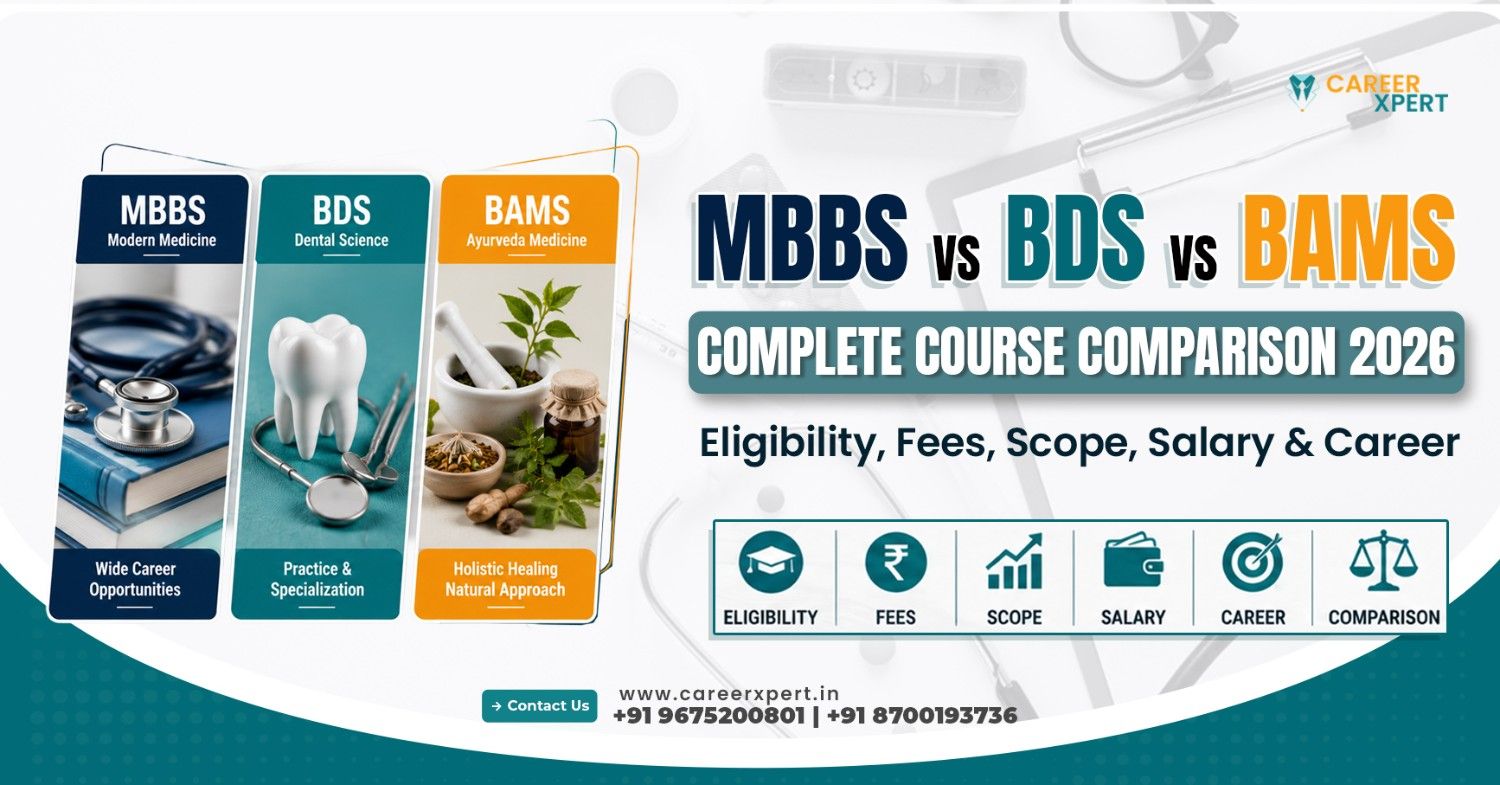

After qualifying NEET, one of the biggest questions for students is: MBBS or BDS or BAMS – which course is best for my future? Every student wants a respected medical career, good salary, stable growth and the right college. But choosing the right course after NEET is not always easy because MBBS, BDS and BAMS are completely different career paths.
Many students keep MBBS as their first preference, but due to high competition, limited government seats and high private college fees, they also consider BDS and BAMS as strong medical career options. That is why a clear MBBS vs BDS vs BAMS comparison is important before NEET counselling 2026.
This blog will help you understand the difference between MBBS, BDS and BAMS based on eligibility, admission process, fees, course duration, career scope, salary and future opportunities.
MBBS, BDS and BAMS are all medical courses after NEET, but their study areas and career paths are different.
|
Course |
Full Form |
Main Field |
Career Outcome |
|
MBBS |
Bachelor of Medicine and Bachelor of Surgery |
Modern medicine |
Allopathic doctor |
|
BDS |
Bachelor of Dental Surgery |
Dental science |
Dentist / Dental surgeon |
|
BAMS |
Bachelor of Ayurvedic Medicine and Surgery |
Ayurveda |
Ayurvedic doctor |
MBBS is related to modern medicine, diagnosis, surgery, emergency care and hospital-based treatment. BDS focuses on dental health, oral diseases, dental surgery and cosmetic dentistry. BAMS is based on Ayurveda, traditional medicine, wellness, Panchakarma and holistic treatment.
MBBS is the most preferred course after NEET UG. Students who want to become allopathic doctors usually choose MBBS. The course includes subjects like Anatomy, Physiology, Biochemistry, Pathology, Pharmacology, Medicine, Surgery, Pediatrics, Orthopedics, Gynecology and Community Medicine.
After MBBS, students can work as doctors or prepare for NEET PG to pursue MD, MS or DNB. MBBS offers wide clinical exposure and strong career growth, especially after postgraduate specialization.
MBBS duration is 5.5 years, including 4.5 years of academic study and 1 year of compulsory internship.
MBBS is best for students who want to become doctors in modern medicine and are ready for long study years, high competition and postgraduate preparation.
BDS stands for Bachelor of Dental Surgery. It is the main course for students who want to become dentists. BDS deals with teeth, gums, oral cavity, dental surgery, oral diseases, orthodontics, prosthodontics, periodontics and cosmetic dental care.
Students comparing MBBS vs BDS comparison should understand that BDS is a specialized medical course. It can offer a good career if the student develops strong clinical skills and chooses the right college.
BDS duration is 5 years, including 4 years of academic study and 1 year of compulsory internship.
BDS is best for students who are interested in dentistry, oral surgery, cosmetic dentistry and private clinic practice.
BAMS stands for Bachelor of Ayurvedic Medicine and Surgery. It is an undergraduate course in Ayurveda. BAMS students study Ayurvedic principles, herbal medicine, Panchakarma, preventive healthcare, anatomy, physiology, pathology and basic modern medical subjects.
For students comparing MBBS vs BAMS or BDS vs BAMS, BAMS can be a good option if they are genuinely interested in Ayurveda and holistic healthcare. The scope of Ayurveda is growing in wellness, lifestyle medicine and preventive health.
BAMS duration is 5.5 years, including 4.5 years of academic study and 1 year of internship.
BAMS is best for students who want to build a career in Ayurveda, wellness, Panchakarma, traditional medicine or AYUSH healthcare.
The basic eligibility for MBBS eligibility 2026, BDS admission 2026 and BAMS admission 2026 is almost similar because NEET UG is required for admission in all three courses.
|
Eligibility Point |
MBBS |
BDS |
BAMS |
|
Entrance Exam |
NEET UG |
NEET UG |
NEET UG |
|
Required Subjects |
Physics, Chemistry, Biology/Biotechnology, English |
Physics, Chemistry, Biology/Biotechnology, English |
Physics, Chemistry, Biology/Biotechnology, English |
|
Minimum Age |
As per NEET rules |
As per NEET rules |
As per NEET rules |
|
Counselling |
MCC/State counselling |
MCC/State counselling |
AYUSH/State counselling |
|
Admission Basis |
NEET rank |
NEET rank |
NEET rank |
Students must qualify NEET UG and participate in the correct counselling process to get admission in MBBS, BDS or BAMS.
After the NEET UG 2026 result, students need to follow the counselling process. Admission is based on NEET score, All India Rank, category, domicile, seat availability, reservation rules and choice filling strategy.
MBBS admission 2026 will be done through All India Quota counselling and state counselling. Students can participate in MCC counselling for All India Quota, deemed universities, central universities and other eligible seats. State counselling authorities conduct counselling for state quota MBBS seats.
BDS admission 2026 is also done through NEET counselling. Students can apply for government dental colleges, private dental colleges and deemed dental universities based on their NEET rank and budget.
BAMS admission 2026 is done through AYUSH counselling and state AYUSH counselling. Students should check college recognition, hospital exposure, OPD/IPD facilities, internship quality and fee structure before choosing a BAMS college.
|
Factor |
MBBS |
BDS |
BAMS |
|
Course Type |
Modern medicine |
Dental science |
Ayurveda |
|
Duration |
5.5 years |
5 years |
5.5 years |
|
Entrance Exam |
NEET UG |
NEET UG |
NEET UG |
|
Competition Level |
Very high |
Moderate to high |
Moderate |
|
Study Pressure |
High |
Moderate |
Moderate |
|
Clinical Exposure |
Very wide |
Dental-focused |
Ayurveda-focused |
|
PG Options |
MD/MS/DNB |
MDS |
MD/MS Ayurveda |
|
Private Practice |
Yes |
Yes |
Yes |
|
Government Jobs |
Good scope |
Limited but available |
Available in AYUSH sector |
|
Long-Term Growth |
Very strong |
Good with specialization |
Good with interest and practice |
MBBS fees in India depend on the type of college. Government medical colleges have lower fees, while private and deemed medical colleges have higher fees.
|
College Type |
Expected Fee Range |
|
Government Medical College |
Low fee |
|
Private Medical College |
Moderate to high fee |
|
Deemed University |
High fee |
|
NRI/Management Quota |
Very high fee |
Students should not check only tuition fees. They must also check hostel charges, security deposit, miscellaneous fees, bond rules, bank guarantee and refund policy.
BDS fees are generally lower than private MBBS fees. Government dental colleges are affordable, while private dental colleges may have moderate fees depending on the state and college reputation.
|
College Type |
Expected Fee Range |
|
Government Dental College |
Low fee |
|
Private Dental College |
Moderate fee |
|
Deemed Dental College |
Moderate to high fee |
BDS can be a practical option for students who want a clinical career but cannot take admission in high-budget MBBS colleges.
BAMS fees also vary from college to college. Government Ayurveda colleges usually have low fees, while private BAMS colleges may charge moderate to high fees.
|
College Type |
Expected Fee Range |
|
Government Ayurveda College |
Low fee |
|
Private Ayurveda College |
Moderate fee |
|
Deemed/National Institute |
Depends on institute rules |
Before choosing BAMS, students should check whether the college has proper hospital facilities, patient flow, internship exposure and approval status.
MBBS offers the widest career scope among these three courses. After MBBS, students can work in hospitals, clinics, government health departments, private healthcare, emergency services, research and public health.
Popular career options after MBBS include:
MBBS becomes even stronger after postgraduate specialization such as MD Medicine, MS Surgery, MD Pediatrics, MS Orthopedics, MD Radiology, MD Dermatology and other branches.
BDS has good scope for students interested in dentistry. After BDS, students can work in dental clinics, hospitals, private practice, dental colleges and cosmetic dentistry setups.
Popular career options after BDS include:
BDS career growth depends on practical skills, location, patient handling, specialization and clinic setup. Students who pursue MDS or advanced dental training can build a strong career.
BAMS has growing scope in Ayurveda, wellness, Panchakarma, preventive healthcare and AYUSH services. Students who are genuinely interested in Ayurveda can build a stable career in this field.
Popular career options after BAMS include:
BAMS can be a good choice if the student is serious about Ayurveda and chooses a good college with strong clinical exposure.
Salary depends on skill, experience, location, college, PG qualification and type of practice.
|
Course |
Starting Salary |
Growth Potential |
|
MBBS |
Good |
Very high after PG |
|
BDS |
Moderate |
Good with clinic/MDS |
|
BAMS |
Moderate |
Good in Ayurveda and wellness sector |
MBBS salary is usually better than BDS and BAMS, especially after PG specialization. A fresh MBBS graduate may start as a junior resident, medical officer or hospital doctor. After MD/MS/DNB, the salary and career opportunities increase significantly.
BDS salary depends mainly on clinical skills and practice setup. A dentist may start with a moderate salary, but income can grow well through private practice, MDS, implantology, orthodontics and cosmetic dentistry.
BAMS salary depends on whether the candidate joins a hospital, works as an AYUSH medical officer, starts an Ayurveda clinic or enters the wellness industry. Income can grow with experience, patient trust and specialization.
In the MBBS vs BDS comparison, MBBS offers broader medical career opportunities, while BDS offers a specialized career in dentistry.
Choose MBBS if:
Choose BDS if:
The MBBS vs BAMS decision depends on your interest in modern medicine or Ayurveda. MBBS is better for students who want a modern medical career with wide hospital exposure. BAMS is better for students who want to work in Ayurveda, wellness and traditional healthcare.
In BDS vs BAMS, both courses offer different career opportunities. BDS is related to dental treatment, while BAMS is related to Ayurveda.
Students should not choose BDS or BAMS only because MBBS is not available. They should choose based on interest, career plan, college quality and future scope.
The Best course after NEET 2026 depends on your NEET rank, budget, interest and long-term goal. There is no single answer for every student.
|
Student Preference |
Suitable Course |
|
Want to become an allopathic doctor |
MBBS |
|
Want to become a dentist |
BDS |
|
Interested in Ayurveda |
BAMS |
|
Want broad PG options |
MBBS |
|
Want dental clinic practice |
BDS |
|
Want wellness/Ayurveda career |
BAMS |
|
Limited budget with good rank |
Government MBBS/BDS/BAMS |
|
Lower rank but medical field interest |
BDS/BAMS after proper analysis |
For most students, MBBS remains the first choice because of its wider scope and strong recognition. However, BDS and BAMS can also provide good careers if chosen with proper understanding.
NEET opens the door to many medical courses. Apart from MBBS, students can also consider BDS, BAMS, BHMS, BUMS, BSMS, BVSc, nursing and allied health science courses.
Some popular medical career options after NEET include:
Students should compare every course based on interest, recognition, practical exposure, salary, job stability and future growth.
Before participating in NEET counselling 2026, students must check:
Choice filling should never be done randomly. A wrong choice can lead to high fees, poor exposure or an unsuitable career path.
MBBS is generally considered the first choice because it offers broad medical scope and strong PG opportunities. BDS is best for students interested in dentistry, while BAMS is best for students interested in Ayurveda and wellness.
Yes, BDS is a good course after NEET 2026 if you are interested in dental science. It offers opportunities in private practice, cosmetic dentistry, oral surgery and MDS specialization.
Yes, BAMS can be good for students who are genuinely interested in Ayurveda, wellness, Panchakarma and traditional healthcare. Career growth depends on college quality, skill and practice.
MBBS usually has higher salary potential, especially after PG. BDS can offer good income through private practice and specialization. BAMS salary grows with experience, clinic setup and Ayurveda practice.
No. NEET UG is required for admission to MBBS, BDS and BAMS in India.
BDS is better for students interested in dentistry, while BAMS is better for students interested in Ayurveda. Both courses are different, so the choice should depend on your interest and career goal.
If you do not get MBBS, you can consider BDS or BAMS after checking your interest, college quality, fees, career scope and future plans. Do not choose any course only because a seat is available.
Private MBBS can be a good option if the college is good and the budget is manageable. But if the fees are very high, students should compare return on investment with BDS and BAMS before taking admission.
Choosing between MBBS vs BDS vs BAMS is an important decision for every NEET 2026 aspirant. MBBS offers the widest scope in modern medicine, BDS gives a focused dental career, and BAMS provides opportunities in Ayurveda and wellness healthcare.
Before deciding on MBBS or BDS or BAMS, students should carefully check their NEET rank, budget, interest, college options and future career goals. All three courses can offer a successful medical career if chosen wisely.
For expert guidance in NEET counselling 2026, MBBS admission, BDS admission, BAMS admission, college selection and choice filling, connect with CareerXpert and make the right decision for your medical future.