NEET PG 2026 Latest Update: Health Minister JP Nadda Reviews Exam Preparedness, Announces Student-Centric Reforms
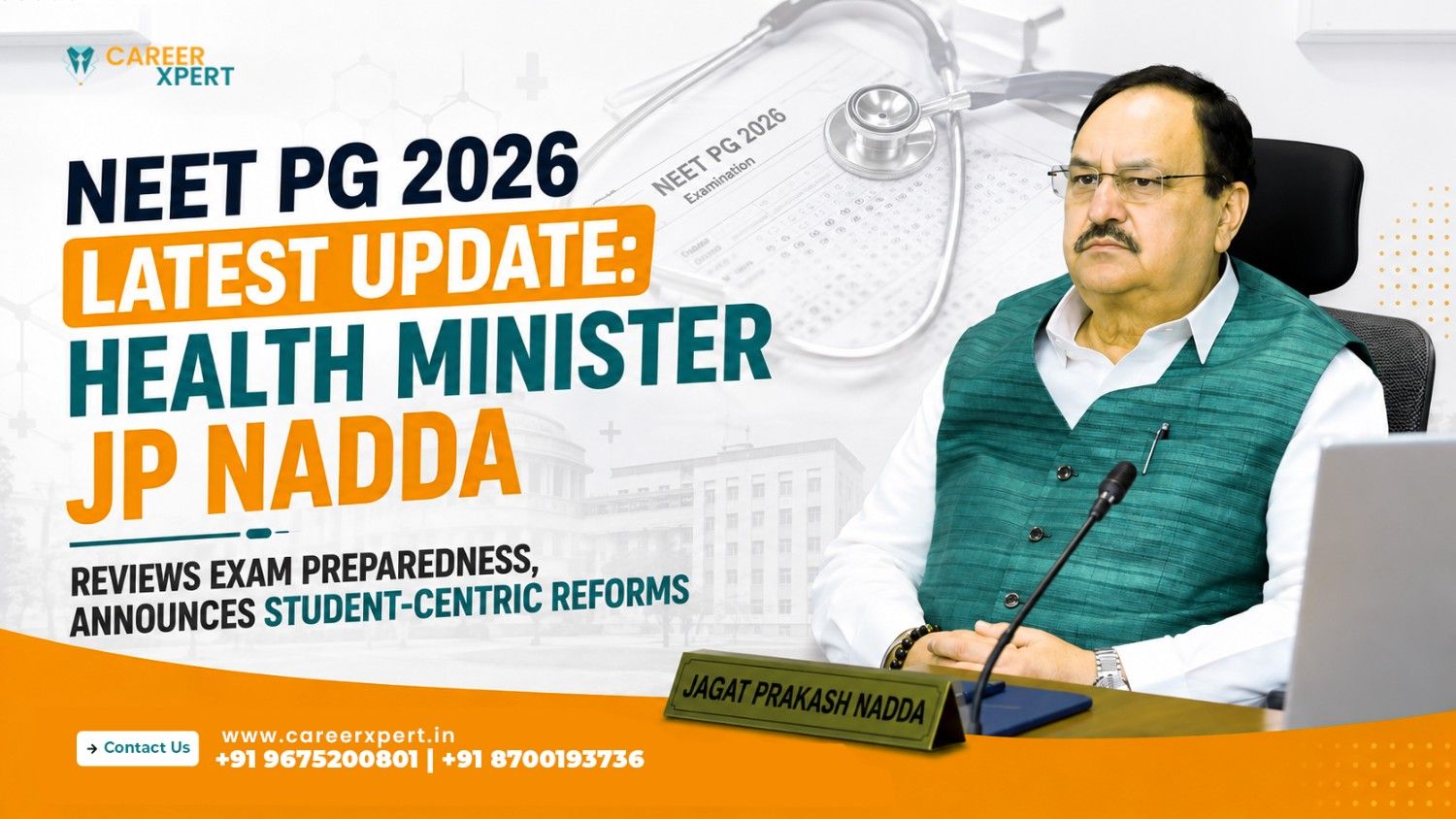

The latest developments around NEET PG 2026 are important for every medical graduate preparing for postgraduate admission. Union Health Minister JP Nadda has reviewed the arrangements for the examination and directed the authorities to ensure that the test is conducted smoothly, securely and transparently.
The review placed equal emphasis on examination security and candidate convenience. The measures discussed include a wider network of test centres, earlier communication of the allotted test city, stronger identity checks, encrypted delivery of examination content and a dedicated system for reporting suspicious activities.
According to the official NBEMS notice, the NEET PG 2026 Exam Date is August 30, 2026. The examination will be conducted through a computer-based platform at centres across the country.
The latest NEET PG 2026 News is especially relevant because more than 2.73 lakh candidates are expected to appear for the examination. The large number of applicants requires careful planning, strong coordination and reliable technology at every stage.
Union Health Minister JP Nadda reviewed the operational, technical and security arrangements made for NEET PG 2026. The discussion covered the complete examination process, from candidate entry and identity verification to question-paper security and live monitoring of test centres.
The meeting focused on whether examination centres are adequately prepared to handle a large number of candidates in a single shift. Authorities were also asked to minimise inconvenience related to travel, centre allocation and last-minute communication.
The key areas reviewed included:
The JP Nadda NEET PG 2026 review reflects the government’s effort to address both examination integrity and student concerns. The emphasis is not only on preventing malpractice but also on making the process easier to understand and manage for candidates.
The official PIB (Press Information Bureau) release list confirms that the Health Minister reviewed preparedness for NEET PG 2026 and highlighted student-centric measures for a secure and transparent examination.
NEET PG 2026 Exam date will be held on August 30, 2026. NBEMS has confirmed that the examination will take place on a computer-based platform at designated examination centres throughout India.
The examination is expected to be organised in a single shift. This means that all candidates will appear under the same broad testing conditions and within the same examination window.
More than 2.73 lakh candidates have reportedly registered for the test. To accommodate them, the examination infrastructure has been expanded across hundreds of cities and more than a thousand centres.
|
NEET PG 2026 detail |
Latest information |
|
Conducting authority |
National Board of Examinations in Medical Sciences |
|
Examination date |
August 30, 2026 |
|
Examination mode |
Computer-based test |
|
Examination shift |
Single shift |
|
Registered candidates |
Approximately 2.73 lakh |
|
Test cities |
Around 340 |
|
Examination centres |
More than 1,300 |
|
Total questions |
180 |
|
Total duration |
210 minutes |
The wider test-centre network is expected to reduce the possibility of candidates receiving centres located very far from their registered address. However, the final allotment of a test city or centre will still depend on capacity, availability and administrative requirements.
Candidates must also remember that the test-city intimation and admit card serve different purposes. The city slip only informs the candidate about the allotted city, while the admit card contains the exact centre address and reporting instructions.
The Health Minister has advised candidates not to trust rumours, fake question-paper offers or misleading claims circulated through social media.
Before major entrance examinations, candidates may receive messages promising confidential information or advance access to the question paper. Such messages are often used to collect money, steal personal data or involve candidates in illegal activities.
Aspirants should be cautious of claims related to:
Candidates should not respond to such offers or share their application number, password, OTP, Aadhaar details or admit card.
The official examination process includes encrypted question-paper delivery and controlled access. Therefore, anyone claiming to possess the final paper in advance should be treated with suspicion.
Candidates should verify every important NEET PG 2026 Latest Update through an official NBEMS or government notice. Messages from unknown Telegram channels, WhatsApp groups or unofficial websites should never be treated as confirmation.
The latest NEET PG 2026 Student-Centric Reforms have been introduced to reduce practical difficulties faced by candidates and improve their overall examination experience.
The reforms focus on four major areas:
One of the major changes is the expansion of the examination network. The NEET PG is expected to be conducted in approximately 340 cities across more than 1,300 centres.
A larger network can improve the chances of candidates receiving an examination city closer to their residence. This is particularly useful for candidates living in smaller cities or regions that previously had limited test-centre availability.
A nearby centre may help reduce:
Candidates should still be prepared for the possibility of receiving a city outside their preferred location. Test-city allotment depends on the number of candidates, centre capacity and operational feasibility.
Earlier test-city information is another important candidate-friendly measure.
Candidates who receive their allotted city well before the examination can make better travel and accommodation arrangements. Early information is especially helpful for those who need to travel by train or air.
Once the test city is announced, candidates should:
The city intimation should not be confused with the admit card. Students must download the admit card separately when it is released.
The revised NEET PG 2026 Exam pattern includes 180 questions to be completed in 210 minutes.
This gives candidates more time per question compared with a paper containing a larger number of questions within a similar duration.
The revised format may be particularly useful for:
However, a lower question count does not guarantee an easier examination. The overall difficulty will depend on the complexity of the questions, subject distribution and the level of clinical application required.
Candidates should practise mock tests designed specifically around 180 questions and 210 minutes. Using an older mock-test pattern may create an inaccurate time-management strategy.
A balanced plan should include:
Candidate authentication has been strengthened to reduce the risk of impersonation.
Aadhaar-based identification, biometric verification and iris authentication may be used at different stages of the examination process. Iris verification can be useful when fingerprint authentication is unsuccessful or unclear.
Candidates should ensure that their application details match their identification records.
They should verify:
NBEMS has advised candidates to enter personal and application information carefully because some details may also be used during counselling and admission-related processes.
Candidates must follow the document instructions printed on the admit card. Any mismatch between the application and identity documents may delay verification at the centre.
The latest NEET PG 2026 Updates include several layers of physical and digital security.
These arrangements aim to protect the confidentiality of examination material, confirm candidate identity and detect suspicious activity without disrupting genuine candidates.
Multi-Layer Security Framework Across Examination Centres
Each examination centre is expected to follow a structured security process.
The framework may include:
NEET PG Candidates should reach the examination centre well before the reporting deadline. Identity verification and security checks may require additional time, particularly at large centres.
Late entry may not be permitted after the gate-closing time mentioned on the admit card.
The examination content is expected to be protected using advanced encryption.
Instead of distributing printed papers in advance, secure digital delivery allows the question paper to remain encrypted until the authorised examination time. Access can be restricted to approved systems and controlled through technical protocols.
This approach helps reduce risks involving:
Candidates should therefore avoid believing anyone who claims to have obtained the final paper before the test.
CCTV surveillance and live monitoring are expected to be used across examination centres.
These systems can help authorities observe:
Biometric verification will be used to confirm candidate identity, while signal-control measures may be deployed to prevent unauthorised electronic communication.
Candidates should cooperate during:
Carrying a prohibited electronic device or attempting to communicate during the examination may result in cancellation of candidature and further action.
More than 60,000 personnel are expected to support the conduct of the examination across the country.
The deployment may include:
Their responsibilities will include candidate entry, technical checks, surveillance, identity confirmation, incident handling and secure closure of the examination.
A large workforce is essential because more than 2.73 lakh candidates are expected to appear in a single shift.
NBEMS has introduced a dedicated mechanism for reporting impersonation, touting and other suspected unfair practices.
Candidates should use the authorised reporting channel when they encounter:
Before reporting an incident, candidates should preserve relevant evidence, such as:
Candidates should avoid engaging further with the sender. They should not transfer money or share personal documents to test whether the offer is genuine.
The reporting system can be effective only when candidates use the official channel and provide clear evidence.
The Health Minister NEET PG 2026 review shows the government’s intention to use technology for both security and candidate convenience.
Digital systems are being used for:
A secure examination should offer equal testing conditions while protecting candidates from technical problems, impersonation and misinformation.
The single-shift format may also reduce concerns about differences between separate question papers or testing sessions.
The government’s approach combines strict security with practical reforms. More centres, earlier city information and improved question timing are meant to support candidates, while biometric verification and encrypted delivery protect the integrity of the examination.
With the NEET PG 2026 Exam Date approaching, candidates should focus on revision and avoid unnecessary changes to their preparation plan.
Practise the Correct Exam Format
Candidates should attempt full-length mocks containing 180 questions and a duration of 210 minutes.
This will help them understand:
Revise High-Yield Topics
The final phase should focus on frequently tested and clinically important areas, including:
Analyse Mock-Test Mistakes
Candidates should review why an answer was incorrect.
Mistakes may result from:
Understanding the reason is more useful than simply checking the correct answer.
Monitor Official Notices
Candidates should regularly check the NBEMS website for:
Prepare Travel Arrangements
After receiving the test-city information, candidates should plan transportation and accommodation. The exact centre route should be checked after the admit card is released.
Keep Required Documents Ready
Documents may include:
Candidates should follow the latest admit-card instructions rather than relying on document rules from earlier years.
Ignore Rumours
Preparation and travel decisions should not be changed because of an unverified social-media post. Every major NEET PG 2026 Update must be checked against an official notice.
|
Key development |
Details |
|
NEET PG 2026 Exam Date |
August 30, 2026 |
|
Examination mode |
Computer-based |
|
Number of shifts |
Single shift |
|
Registered candidates |
Around 2.73 lakh |
|
Examination cities |
Approximately 340 |
|
Test centres |
More than 1,300 |
|
Revised paper format |
180 questions |
|
Total time |
210 minutes |
|
Student-focused measure |
Wider test-location availability |
|
Travel support |
Earlier city intimation |
|
Identity security |
Aadhaar, biometric and iris verification |
|
Centre monitoring |
CCTV and live surveillance |
|
Question-paper protection |
Encrypted digital delivery |
|
Personnel deployment |
More than 60,000 |
|
Complaint mechanism |
Dedicated unfair-practice reporting system |
The official NBEMS notice confirms that NEET PG 2026 will be held on August 30, 2026, on a computer-based platform.
When will NEET PG 2026 be conducted?
NEET PG 2026 will be conducted on August 30, 2026. It will be held through a computer-based platform at examination centres across India.
How many candidates have registered for NEET PG 2026?
Approximately 2.73 lakh candidates have reportedly registered for the examination. The large candidate count is one reason for expanding the test-centre network and deploying a significant number of examination personnel.
What are the new student-centric reforms in NEET PG 2026?
The major reforms include more test locations, earlier communication of the allotted city, a single-shift examination, a revised 180-question format and stronger identity-verification arrangements.
What changes have been made to the NEET PG 2026 exam pattern?
The examination is expected to contain 180 questions to be completed within 210 minutes. Candidates should practise mock tests based on the revised pattern.
What security measures have been introduced for NEET PG 2026?
The security arrangements include Aadhaar and biometric authentication, possible iris verification, CCTV surveillance, live monitoring, candidate frisking, encrypted question-paper delivery and controlled entry into examination centres.
What should candidates do if they receive fake exam-related messages?
Candidates should not make payments, open suspicious links or share personal information. They should save screenshots and report the incident through the official NBEMS reporting mechanism.
The latest NEET PG 2026 News indicates that the examination authorities are focusing on both security and candidate convenience.
NEET PG 2026 is scheduled for August 30, 2026. The test is expected to be conducted in a single shift for approximately 2.73 lakh candidates across a wide network of examination centres.
The major NEET PG 2026 Student-Centric Reforms include expanded test locations, earlier city information and a revised examination pattern of 180 questions in 210 minutes. These measures may make travel planning easier and provide candidates with more time to evaluate each question.
At the same time, Aadhaar verification, biometric checks, iris authentication, CCTV surveillance and encrypted question-paper delivery are intended to make the examination more secure.
Candidates should now focus on structured revision, mock-test analysis and exam-day preparation. They should follow only official NBEMS notices and immediately ignore or report messages offering leaked papers, guaranteed ranks or access to confidential examination material.